Our Location
304 North Cardinal St.
Dorchester Center, MA 02124
304 North Cardinal St.
Dorchester Center, MA 02124

:400300-1024x768.jpg)
In modern industrial production, many companies find that traditional lifting equipment can no longer meet the demands for efficiency, safety, and precision, which raises the question: why are smart gantry cranes becoming increasingly important? In fact, smart gantry cranes, through automation, sensor technology, and data monitoring, bring industrial lifting into a new intelligent era, helping industries such as manufacturing, steel processing, logistics, road and bridge construction, railway maintenance, and port operations achieve more efficient material handling.
So, what are the limitations of traditional gantry cranes? Early models were simple structures, often equipped with manual or semi-electric hoists. While suitable for repetitive lifting tasks, they lacked flexibility and precise control. Modern smart gantry cranes incorporate electric drives, adjustable spans, and optimized steel structures, enabling them to handle heavier loads with greater accuracy. Features like anti-sway systems, remote control, and real-time monitoring significantly reduce downtime and human error.
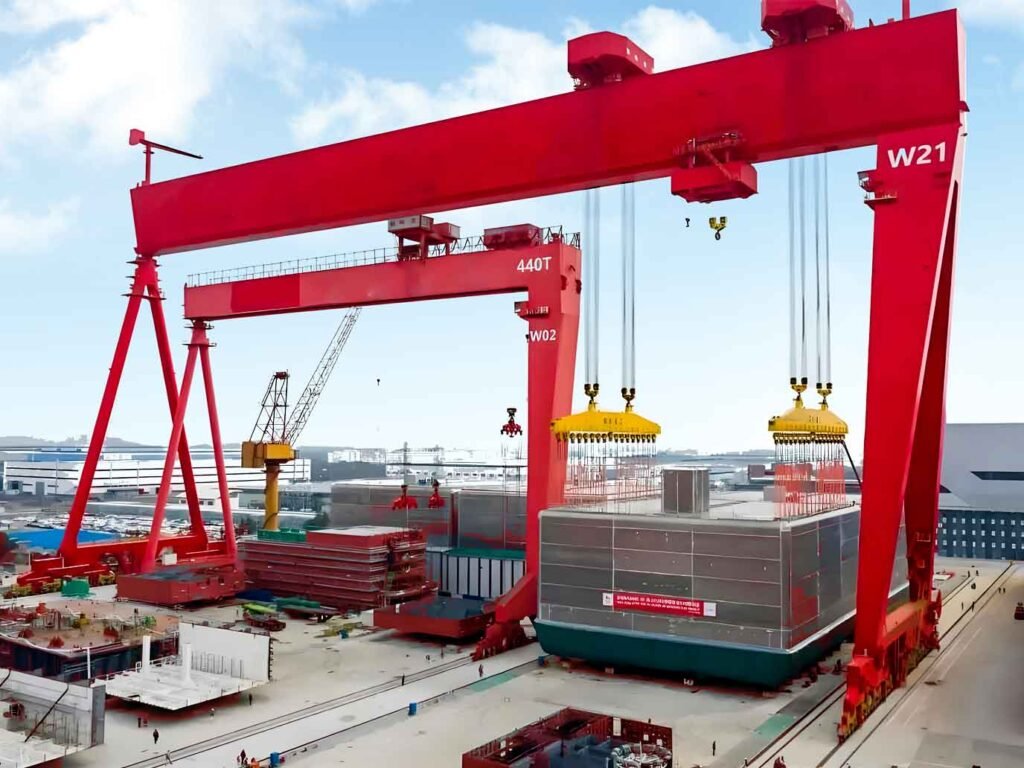
Many people also wonder: where can smart gantry cranes be applied? In manufacturing workshops, single- and double-girder cranes efficiently transport materials between workstations; in outdoor steel fabrication yards, precast concrete factories, or long material handling, they easily manage oversized or heavy loads; in subway construction and bridge projects, mobile and rubber-tired gantry cranes operate efficiently in narrow or uneven areas; and ports rely on rail-mounted gantry cranes (RMG) and rubber-tired gantry cranes (RTG) for container stacking and continuous operations. Special tasks like slag handling, waste processing, and automated scrap loading also require cranes equipped with grapples, magnets, or protective systems.
Why do companies invest in smart gantry cranes, and what problems do they solve? Enterprises face challenges such as lifting bottlenecks, safety risks, low material flow efficiency, and limited workspace utilization. Steel mills, foundries, concrete factories, logistics warehouses, wind-power equipment plants, shipyards, and government construction projects find that smart gantry cranes streamline production, shorten project timelines, enhance safety, and reduce long-term operational costs.
However, industrial environments are complex, and gantry cranes can encounter various challenges. Hoist brake wear, trolley imbalance, motor overheating during continuous operation, structural fatigue under extreme weather, control system interference, or sway when lifting long materials are common issues. In subway or tunnel projects, confined and humid spaces further increase difficulty, while slag or waste handling exposes cranes to high temperatures, dust, and corrosive fumes, requiring high-strength materials and sealed protection.
So, how can smart gantry cranes operate reliably over time? Regular maintenance is essential. Lubrication, structural inspections, brake adjustments, and electrical checks form the basics, while digital monitoring systems track operating hours, load cycles, and vibration to predict maintenance needs before breakdowns occur. Timely replacement of worn parts, keeping rails or tires aligned, and cleaning and calibrating sensors all extend crane lifespan. Operators must also avoid overloading, maintain proper lifting angles, and ensure smooth communication between the ground staff and control room.
Operational safety is equally important. Operators should inspect hooks, wire ropes, and limit switches before each shift, avoid running the crane over personnel, prevent sudden stops, and stay alert in windy or unstable environments. For smart cranes equipped with remote control or cameras, familiarity with the digital interface ensures precise positioning. Additional protective measures and site coordination are needed when handling molten slag, working near railways, or lifting oversized structural components.
Finally, many companies ask: what does the future hold for smart gantry cranes? As industrial automation and digitalization advance, their role in modern lifting will only grow. Whether it’s lightweight European-style cranes for workshops, heavy-duty double-girder cranes for steel yards, or intelligent port cranes managing container flows, smart gantry cranes remain indispensable for efficient material handling. Their evolution from simple structures to intelligent, connected systems reflects the ongoing transformation of global manufacturing and infrastructure development.
If you are wondering, “Which gantry crane model is best suited for my factory or project?” we can provide customized solutions, professional technical support, and project advice to deliver precise, efficient, and reliable industrial lifting solutions tailored to your real working conditions.